

Narrow strip creates a particular problem for both the processor and the customer. When a 20 mm or 25 mm wide strip is wound in the conventional way, each wrap sitting directly on top of the last, the result is a ribbon or “pancake” coil. It is tall, narrow and holds relatively little material. A customer feeding that strip into a roll former, tube mill or stamping press has to stop and change coils frequently, and every change costs time.
Traverse winding for narrow strip, also called oscillate winding, takes a different approach. Instead of stacking every wrap in one line, the strip is guided back and forth across the width of a wide spool, so that each wrap lies beside the previous one. This article explains how traverse winding works, when it makes sense, what parameters matter and how it fits into a narrow-strip processing line. It focuses on metal strip winding. Supported materials and dimensions vary by machine and must be confirmed for each application.
Ribbon Coils and Their Limits
A ribbon-wound coil has a single stack of wraps, with the edges flush. It is simple to produce on a slitting line recoiler and is the most common way to supply slit strip. For narrow widths, though, ribbon coils have practical limits:
- Limited length per coil: A narrow strip can only be wound to a certain outside diameter before the coil becomes unstable or too heavy for its width.
- Frequent changeovers: The customer has to load, thread and splice coils more often.
- Handling and stability: Tall, narrow coils are prone to collapse or telescoping if handled poorly.
- Storage space: Many small coils take up floor and rack space.
How Traverse Winding Works
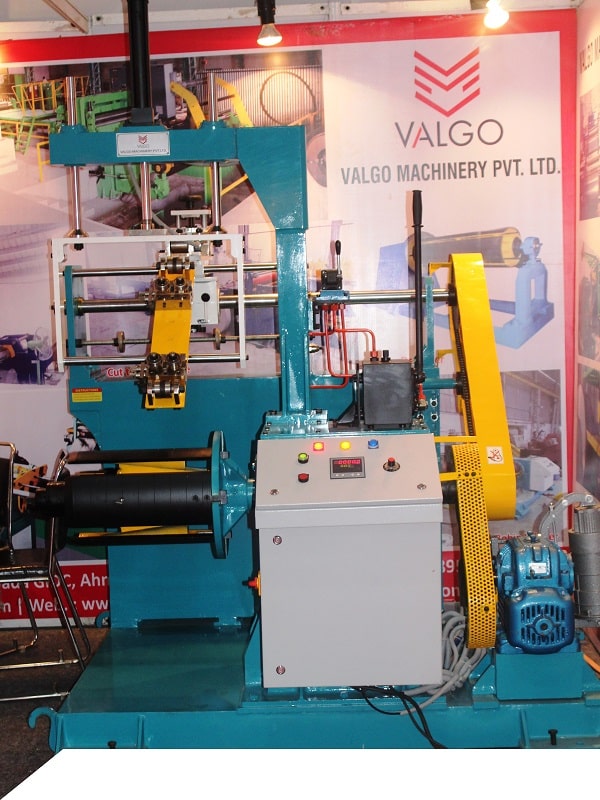
In a traverse winder, the strip is wound onto a wide former or core while a guide moves the strip back and forth along the width of the spool. Each wrap lies next to the previous one, building a wide package layer by layer, much like thread on a spool. Valgo’s strip oscillating winder page describes the principle: the winding motion oscillates from side to side to distribute material evenly across the width of the coil, with tension control to maintain consistent winding.
To make a long continuous package, several slit coils are often joined end to end before winding. The US strip producer Ulbrich, in a comparison of ribbon and oscillate-wound coil, explains that several ribbon coils become one long continuous strip, and that an oscillate-wound coil can hold many times the length of a single pancake coil.
Where Traverse-Wound Strip Is Used
Traverse winding is most useful wherever a downstream process consumes narrow strip continuously and frequent coil changes are costly. Typical applications include:
- Roll forming of narrow profiles
- Small-diameter tube and pipe production
- High-volume stamping with progressive dies
- Strip for electrical and electronic components
- Strapping and similar continuous products
The Ulbrich article notes that oscillate winding suits high-volume stamping and narrow-width slit steel, and that it can protect thin or soft surfaces and edges.
Parameters That Matter
Strip dimensions and material
Strip width, thickness and material determine whether traverse winding is practical and how the machine must be configured. Valgo’s bobbin winder machine, for example, is specified for single strip up to 25 mm wide and 0.2 to 1.2 mm thick in soft annealed mild steel of DD and EDD grades. Other materials and dimensions need their own review.
Finished package dimensions
The width, inside diameter, outside diameter and weight of the finished traverse-wound coil must suit the customer’s payoff equipment. The Valgo bobbin winder, for instance, is specified for finished coils up to 500 mm wide, up to 1,250 mm outside diameter and up to 2,000 kg, wound on 300 mm or 400 mm inside-diameter cardboard cores on an adjustable former.
Traverse pitch and coil build
The distance the guide moves for each revolution, together with the strip width, decides how wraps sit against each other. If the pitch is wrong, wraps can overlap or leave gaps, which affects package stability and payoff.
Tension
Consistent tension keeps the package firm without stretching or damaging the strip. Tension that is too low gives a loose package that can shift; too high can deform thin strip.
Speed synchronisation
The guide’s traverse speed must stay synchronised with the winding speed as the package builds. On the Valgo bobbin winder, the strip guide’s linear speed is automatically synchronised with the coiler speed, with a maximum winding speed of 200 m/min.
Length measurement
A length counter allows the operator to wind a set length of strip per package, which helps match the package to the customer’s order.
Integration with Slitting and Packing
Traverse winding usually sits downstream of a narrow-strip slitting operation. Planning the integration involves:
- Supplying slit coils of suitable width, edge quality and cleanliness
- Joining coils end to end, where the process requires it, with joints that will pass through the customer’s equipment
- Handling finished packages, which are heavier and wider than ribbon coils
- Strapping and packing for transport. Ulbrich notes that oscillate-wound coils are secured with high-tensile steel strapping on skids
Edge quality from the slitting stage carries through to the wound package. Burr or camber on the slit strip can cause problems during winding and payoff, so slitting setup matters as much as the winder itself.
Questions for Your Supplier
- What strip widths, thicknesses and materials can the winder handle?
- What finished package width, ID, OD and weight are possible?
- How is traverse pitch set and adjusted for different strip widths?
- How is tension controlled and kept consistent as the package builds?
- What core or former sizes are supported?
- How is the package removed and strapped?
- What controls, drives and length measurement are included?
Conclusion
For narrow strip, traverse winding can turn many short ribbon coils into one long, stable package, giving downstream users fewer changeovers and making handling and storage easier. The benefits depend on matching the winder to the strip dimensions, material and customer equipment, and on supplying well-slit strip to begin with.
To discuss your strip dimensions, materials and winding requirements, Contact Valgo Group.
