

Flat sheet is one of those requirements everyone agrees on until it has to be defined. A laser-cutting customer may call a sheet “not flat” because it rocks on the cutting table. A panel fabricator may reject a sheet that looks flat on the stack but springs into a bow when it is cut into blanks. Both complaints land on the cut-to-length line, and both are about sheet metal leveling: what it can correct, what it cannot, and how flatness should be measured.
This article is for production and quality teams who run or buy coil-to-sheet processing. It explains the common shape defects, why they occur, the variables that influence results after leveling, and how to agree on flatness with customers.
What “Flatness” Actually Means
Flatness describes how closely a sheet lies to a flat reference plane when it rests on a surface without being held down. In practice there are two related ideas:
- Visible shape: waves, bows or buckles that can be seen and measured on the sheet as cut.
- Latent shape: internal stresses that do not show while the sheet is whole but appear when it is cut, punched, lasered or heated.
A sheet can pass a visual flatness check and still be a problem for a downstream laser or punching operation if it carries significant trapped stress. That distinction is the key to understanding what leveling does.
Common Shape Defects in Coil-Fed Sheet
Coil set
When strip is wound into a coil under tension, the outer wraps end up slightly longer than the inner wraps. Uncoiled, the strip keeps a lengthwise curvature called coil set. As explained in The Fabricator‘s guide to roller leveling fundamentals, coil set is caused by winding a coil under tension. Because the inner wraps are wound on a smaller radius, coil set is usually more pronounced towards the inside of the coil.
Crossbow
Crossbow is curvature across the width. It can come from the mill, and it can be introduced by an imperfect slitter setup upstream.
Edge wave
Edge wave appears when the edges of the strip are longer than the centre, so the extra length forms ripples along the edges.
Centre buckle
Centre buckle is the opposite condition: the centre is longer than the edges and forms a raised or rippled area along the middle of the sheet.
Twist and bow after cutting
Some sheets look acceptable but distort when they are cut into parts. This comes from residual stresses that were not adequately relieved and are released when material is removed.
Why Incoming Coil Condition Matters
Most shape defects originate before the coil reaches the cut-to-length line. Rolling, cooling, coating and winding all leave their mark. A technical article in The Fabricator on flatness in coil processing operations describes mill-induced stresses as random, varying across the width and along the length of a coil. The same article cautions that if trapped stresses are released by cutting or heating, the material will not stay flat.
For production teams, that means two practical things. First, the condition of the incoming coil sets the starting point, so it is worth recording which defects are present before processing. Second, the same leveller setting will not give identical results on every coil, even of the same nominal grade, because each coil carries a different stress pattern.
What Leveling Does, and Its Limits
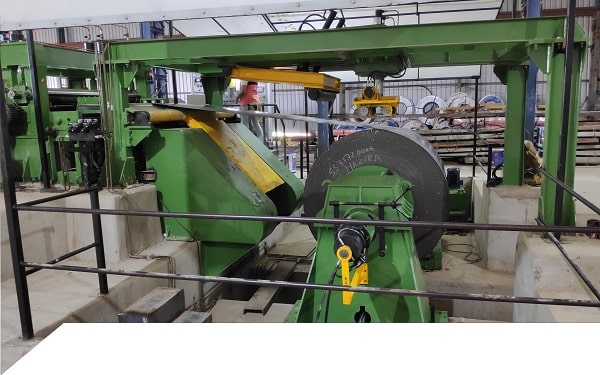
A roller leveller passes the strip through a series of small-diameter work rolls, set in an offset pattern, that bend it alternately up and down. The entry rolls are set deeper than the exit rolls, so the bending reduces as the strip moves through the machine. When the bending takes the outer fibres of the material beyond its yield point, they deform plastically and the original stress pattern is redistributed. The exit rolls then determine the final shape the customer sees.
Two points about the limits of leveling are worth understanding:
- Light leveling flattens without relieving stress. The Fabricator’s roller leveling guide warns that a light touch can remove visible coil set while leaving internal stresses in place. The sheet looks flat, then moves when it is cut.
- Roller leveling does not yield the full thickness. In conventional roller leveling, a core of material around the neutral axis stays below yield. Tension or stretcher leveling, which pulls the material past yield across its whole cross section, can produce lower residual stress. It is usually applied to thinner gauges because of the forces involved.
This is why flatness requirements and downstream processes should be discussed before a line is specified. A sheet that only needs to stack neatly has very different requirements from one that will be laser-cut into precision parts.
Process Variables That Influence Flatness
Leveller selection for thick hot-rolled plate is a topic in itself, covered in our guide to choosing a leveller and shear for HR cut to length lines. Here, the focus is on the variables that production teams adjust and monitor day to day.
- Roll penetration (plunge): The depth of bending at the entry. Too shallow and stress is not adequately relieved; too deep can introduce new shape problems.
- Exit gap: The final roll setting has a strong influence on residual bow. It is typically set close to the material thickness.
- Backup roll or flight adjustment: Where the leveller allows adjustment across the width, the operator can work the centre or the edges to correct centre buckle or edge wave. The principle is to lengthen the short areas, not to press harder on the areas that look worst.
- Material properties: Yield strength, thickness and width all change the bending effect of a given setting. Higher-strength material needs more working to reach the same result.
- Roll condition: Worn, marked or contaminated rolls affect both shape and surface finish.
- Strip tracking and tension: A strip entering the leveller off-centre or with uneven tension will not be worked evenly across its width.
Because settings interact, many plants keep a record of proven settings for each grade and thickness and use it as a starting point, then fine-tune on the first sheets of every coil. Flatness problems on cut-to-length lines and their troubleshooting are also covered in our article on common problems in cut-to-length lines.
How to Inspect and Agree on Flatness
Flatness disputes usually come down to measurement. A clear inspection method avoids them.
- Use a flat reference surface. Lay the sheet on a flat table or inspection surface without clamping it.
- Measure wave height and wave length. A wave of a given height is more severe over a short length than a long one. Units that combine both, such as I-units, are widely used in the industry to express flatness on this basis.
- Check after a test cut where it matters. For laser-cut or blanked parts, cutting a sample strip or part from the sheet reveals latent stress that a flatness check alone will miss.
- Sample through the coil. Shape often changes from head to tail, especially coil set near the inner wraps. Check sheets from several points.
- Write the requirement down. State the acceptance criterion, the method and the standard or customer specification that applies.
Questions to Ask When Specifying Leveling Capability
- What materials, thicknesses, widths and yield strengths will be processed?
- What shape defects are typical in our incoming coils?
- What will customers do with the sheet: stack, fabricate, laser-cut, paint or form?
- Is visual flatness enough, or is low residual stress required?
- Does the application call for roller leveling, or should stretcher or tension leveling be considered?
- How will flatness be measured and accepted during trials?
Conclusion
Good flatness after leveling is the product of incoming material condition, leveller capability, correct settings and a clear inspection method. No leveller can make every coil perfectly flat, but understanding what is being corrected, and whether the downstream process needs visible flatness or stress relief, makes the outcome far more predictable.
Valgo’s Cut to Length Line range and wider Coil Processing Solutions include levelling options for different material and output needs. If you are reviewing flatness on an existing line or planning a new one, discuss your material condition and flatness expectations with Valgo Group.
