

Two cut-to-length lines can have the same thickness range, the same maximum width and the same leveller, and still behave very differently in production. The difference often lies in how the line cuts: whether the strip stops for every cut, keeps moving while a looped section is indexed forward, or runs continuously while the shear moves with it. That one choice affects output, sheet length accuracy, surface quality, foundations and cost.
This article compares the main cutting approaches used in a flying shear cut to length line and its alternatives, so production planners and buyers can understand which method fits their material and output. It focuses on the cutting method rather than general cut-to-length line components or leveller selection. Actual performance depends on the specific line design, material and sheet length, and should be confirmed with the manufacturer.
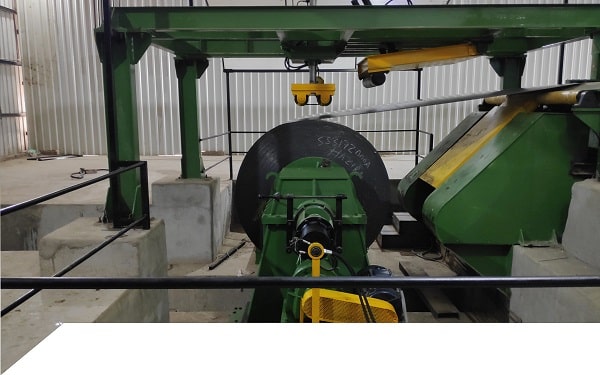
Three Ways to Cut Sheets from a Coil
All cut-to-length lines uncoil, level, measure and cut strip into sheets, then stack them. The cutting section, and how the strip moves through it, is what separates the main configurations:
- Start-stop lines, in which the strip stops for each cut
- Looped lines with an indexing feeder, in which the decoiler and leveller run continuously while a feeder after the loop starts and stops the strip at the shear
- Continuous lines with a flying or rotary shear, in which the strip keeps moving and the shear cuts on the move
Valgo’s published cut to length line range reflects these approaches: a “Flycut” model with a flying shear, a “Servocut” loop line, and start-stop lines for hot-rolled material, alongside customised designs.
Start-Stop Lines
How they work
The whole line, or the feeding section, accelerates the strip, stops it when the measured length is reached, and the shear cuts while the strip is stationary. The cycle then repeats.
Strengths
- Mechanically straightforward and generally lower in cost
- Stationary cutting makes it easier to hold length accuracy
- Well suited to thick, heavy material, where the strip is stiff and difficult to loop
Limitations
- Output is limited by the acceleration and deceleration cycle
- Repeated starts and stops increase wear on drives and feeders
- On sensitive surfaces, repeated acceleration can increase the risk of marking
A technical article in The Fabricator on cut-to-length line developments notes that in start-stop lines the strip is accelerated and decelerated for each cut, which can cause faster component wear, but that a tight line without loops can be a good choice for thick, typically hot-rolled material. Valgo’s HR cut to length line follows this pattern for heavy-gauge coils.
Looped Lines with an Indexing Feeder
How they work
The decoiler and leveller run at a steady speed and feed into a loop, often in a pit. After the loop, a feeder, typically a servo roll feed or grip feed, indexes the strip forward by the required sheet length, stops it, and the shear cuts. The loop absorbs the difference between continuous levelling and intermittent feeding.
Strengths
- The leveller runs continuously, which supports consistent flatness
- Servo feeders can position the strip accurately for each cut
- Output is generally higher than a simple start-stop line, because only the light section after the loop has to stop
Limitations
- The loop pit adds civil cost and fixes the line’s position in the building
- Loops are better suited to thinner and medium gauges; very thick material is difficult to loop
- For some materials, the way the strip hangs in the loop can affect flatness, which needs to be considered in design
Valgo’s Coil Processing Solutions range describes cut-to-length lines that can be equipped with either grip feed or servo roll feed measuring systems.
Continuous Lines with a Flying or Rotary Shear
How they work
The strip runs continuously at line speed. The shear is synchronised with the moving strip so it cuts on the move. In a traditional flying shear, the shear travels with the strip during the cut and then returns. Rotary shears and other designs achieve the same goal with different mechanics.
Strengths
- No need to accelerate and decelerate the strip for each cut
- High throughput potential, particularly for thin material and longer runs
- Smoother strip movement can reduce slippage and surface marking
- No loop pit is required in many designs
The Fabricator article notes that because the strip does not need to be accelerated and decelerated for each cut, the risk of strip slippage is reduced, and that in fast continuous lines the stacker often becomes the limiting factor.
Limitations
- More complex mechanics and control, with higher equipment cost
- Traditional flying shears are limited by the mass and inertia of the moving shear, which constrains cutting frequency on short sheets
- Very thick material requires heavier shears, which makes flying designs harder to apply
- Stacking has to keep pace with the cutting rate
How to Choose the Cutting Method
| Factor | Start-stop | Looped with indexing feeder | Continuous with flying or rotary shear |
|---|---|---|---|
| Typical material | Thick, heavy gauge, hot-rolled | Thin to medium gauge | Thin to medium gauge, high volume |
| Output potential | Lower | Medium to high | High |
| Civil works | Usually no loop pit | Loop pit or equivalent | Often no loop pit |
| Mechanical complexity | Lower | Medium | Higher |
| Short sheet lengths | Suitable, at lower speed | Suitable | Depends on shear design |
This comparison is general. A particular line’s performance depends on its design, drives, controls and stacker. Use it as a starting point for discussion with your supplier, not as a specification.
Questions to Answer Before Deciding
- What thickness range will make up most of your tonnage?
- What sheet lengths do you cut most often, and how short is the shortest?
- What length and diagonal accuracy do your customers require?
- How important is surface quality?
- Can your building accommodate a loop pit?
- What output do you need per shift, and can your stacking and packing keep up?
- Will you add punching, trimming or other in-line processes later?
Information to Send with Your Enquiry
To recommend a cutting method, a manufacturer needs your material grades and thickness range, coil width, weight and ID, sheet length range and tolerance, stack requirements, target output and site details. Valgo’s HR cut to length line page, for example, lists cutting ranges, coil ID ranges and length and diagonal accuracy for its models, which shows the kind of information that needs to be matched to your requirements.
Conclusion
Start-stop, looped and continuous cutting each have a place. Start-stop lines suit heavy material and simpler requirements. Looped lines with indexing feeders balance continuous levelling with accurate feeding. Continuous lines with flying or rotary shears suit high-volume work on thinner material. Matching the method to your material, sheet lengths and output is one of the most important decisions in specifying a cut-to-length line.
Explore Valgo’s Cut to Length Line range, and send us your material, sheet dimensions and production requirements to discuss the most suitable configuration.
