
A coil processing line is usually bought on its specification sheet: thickness range, width, coil weight, line speed. Yet some of the most expensive problems in a new plant have little to do with the machine itself. A crane that cannot reach the entry coil car. A finished-coil area that blocks the forklift route to dispatch. A hydraulic power pack placed where it can only be serviced by stopping the line. These are layout problems, and they are far cheaper to solve on paper than in concrete.
This article sets out a practical approach to coil processing line layout planning. It is written for plant owners, project engineers and production managers preparing a new building, an extension, or a line relocation. It focuses on site planning rather than equipment selection, and every point here should be validated against your own site conditions and the drawings supplied by your equipment manufacturer.
Start with Material Flow, Not Machines
The most useful first drawing is not a machine layout. It is a material-flow diagram that shows how a coil moves from the truck to the customer:
- Incoming coil unloaded from the truck or trailer
- Inspection and identification
- Raw coil storage
- Transfer to the line entry
- Processing (slitting, cutting to length, or both)
- Exit handling of slit coils, sheet stacks or scrap
- Packing, weighing and labelling
- Finished-goods storage
- Loading for dispatch
Draw this flow onto the building plan before placing any equipment. The goal is a route that moves in one general direction with as few crossings, reversals and double handling steps as possible. Where incoming and outgoing material cross, or where a forklift has to pass through an operator area, those are points to redesign.
If you are planning a complete steel service centre, our earlier guide on starting a steel service centre in India covers machine selection and business models. This article goes deeper into the layout itself.
Loading and Unloading Access
Coil handling method
Decide early how coils will be lifted and moved: overhead crane, coil car, forklift with a coil ram, or a combination. This decision drives crane span and hook height, floor loading, aisle widths and the position of the line relative to the crane bay.
Entry side
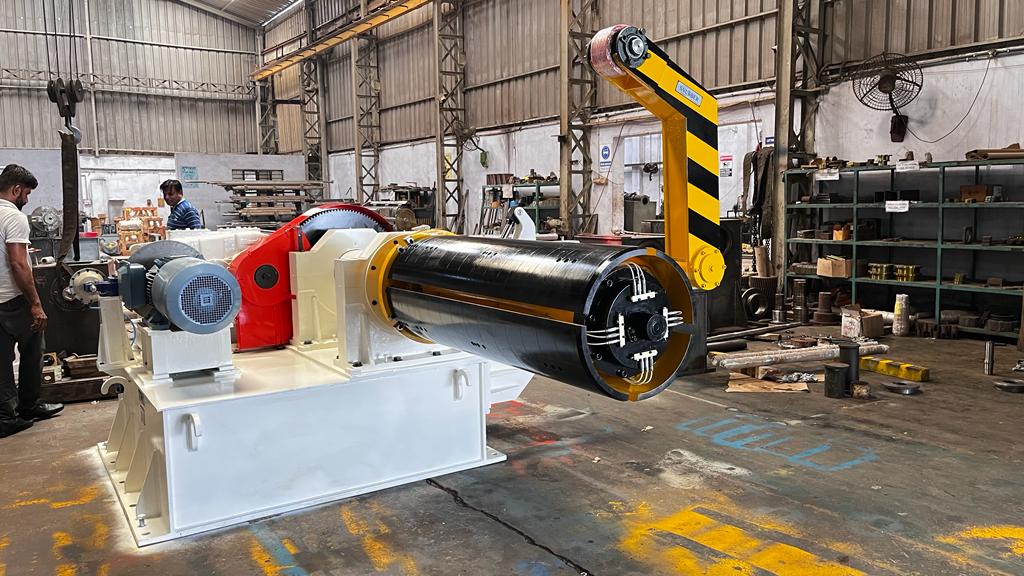
The decoiler needs a clear approach for loading. Check that the crane hook can reach the coil car or decoiler mandrel with the heaviest and largest coil you plan to process, and that the coil can be lowered without swinging over operator positions. Heavy-gauge lines can be rated for very large coils; Valgo’s published HR cut to length line models, for example, list coil weights of up to 35 tonnes, which has obvious implications for crane capacity and floor design.
Exit side
Exit handling is often under-planned. A slitting line produces several coils per master coil, each of which must be removed, packed and stored. A cut-to-length line produces stacks that need to be lifted or conveyed away. Allow space for the exit coil car, turnstile or stacker, and for the packing operation that follows.
Crane safety
Where overhead cranes are used, their installation, clearances and inspection must follow applicable regulations and the crane manufacturer’s instructions. As a reference, the US standard OSHA 29 CFR 1910.179 for overhead and gantry cranes sets minimum clearances between cranes and obstructions and requires regular inspection. Plants in India should follow the applicable national and state occupational safety regulations for lifting equipment, along with the crane supplier’s guidance.
Storage Areas
- Raw coil storage: Size it for your expected inventory, not just today’s volume. Consider coil saddles or cradles, safe stacking practice and separation by grade.
- Work-in-progress: Leave space near the line entry for the next coil to be staged so loading does not wait on the crane.
- Finished goods: Place it near dispatch. Slit coils and sheet stacks need different storage arrangements.
- Tooling and spares: Slitter knives and spacers need clean, protected storage close to the line. A tooling room or cabinet near the slitter head shortens changeovers.
- Scrap: Edge trim and scrap need a collection point and a removal route that does not interfere with production.
Utilities and Foundations
Utility and civil requirements come from the equipment manufacturer’s foundation and installation drawings. Common items to coordinate early include:
- Foundation design, including any pits for loops, scrap handling or coil cars
- Electrical supply capacity and the position of control panels and cable routes
- Compressed air, where pneumatic systems are used
- Hydraulic power pack location, with space for maintenance and oil handling
- Lighting levels over inspection points and operator stations
- Drainage and spill containment around hydraulic equipment
Pit depths, anchor bolt positions and foundation loads are specific to each line. Your civil engineer should work from the manufacturer’s certified drawings, not from general guidance.
Operator Space, Access and Safety
Machinery safety is first a matter of design. The international standard ISO 12100 on risk assessment and risk reduction for machinery sets out the general approach: identify hazards, evaluate risk and reduce it through design, safeguarding and information. Layout decisions are part of that process.
- Operator stations: Place control desks where operators can see the critical parts of the process, such as the slitter head, recoiler or stacker.
- Walkways: Mark pedestrian routes clearly and keep them separate from crane and forklift paths wherever possible.
- Guarding and fencing: Allow space for guards, interlocked gates and safety fencing, along with access for setup.
- Emergency access: Keep emergency stops reachable and exit routes clear.
Maintenance Access
A layout that works for production but not for maintenance will cost time for the life of the line. Plan for:
- Clearance to remove and replace slitter arbors, leveller rolls, shear blades and recoiler mandrels
- Crane coverage over heavy components that may need to be lifted out
- Access to both sides of the line where adjustments or inspections are required
- Space around the hydraulic power pack, gearboxes and motors
- Room to bring in a forklift or trolley for tooling changes
Plan for the Next Line
Many processors start with one line and add a second within a few years, often a cut-to-length line beside a slitting line, or a packing line at the exit of an existing slitter. Leaving a reserved footprint, with crane coverage and utility capacity, makes a future expansion far less disruptive. Valgo’s coil packing lines, for example, are designed to integrate with slitting lines, which is easier to plan from the start than to retrofit.
Validate the Drawings
Before construction, review the layout with everyone who will use or maintain the plant: production, maintenance, safety, logistics and the equipment supplier. Walk through the material flow on the drawing step by step. Then check:
- Does the heaviest coil reach the decoiler safely?
- Where does each finished product go, and how?
- Can every major component be removed for maintenance?
- Are pedestrian and vehicle routes separated?
- Do civil drawings match the manufacturer’s foundation drawings?
- Is there space for the next line?
Conclusion
The layout of a coil processing plant decides how easily material moves, how safely people work and how quickly maintenance can be done, every day for many years. Building it around material flow, handling, utilities and access, then validating it against real site conditions, avoids the kind of problems that are costly to fix once the line is installed.
Explore Valgo’s Coil Processing Solutions or read About Valgo Group. If you are planning a new plant or an expansion, discuss your layout and material-flow requirements with our team.
