“Can the line run stainless steel as well?” It is one of the most common questions in a coil processing enquiry, and it is a reasonable one. Many processors handle more than one material, and most would like a single line to do it all. The honest answer is that it often can, but only if the line has been specified with every material in mind, and only if the setup is changed for each one.
Carbon steel, stainless steel and aluminium behave differently when they are slit, levelled, cut and wound. This article explains the main differences in general terms, so production and procurement teams can see why metal coil processing requirements vary by material and what information an equipment manufacturer needs to configure a line properly. It is not a settings guide. Actual knife clearances, leveller settings, speeds and tensions depend on the specific grade, temper, thickness and finish, and must be established for each application.
Why Material Matters in Coil Processing
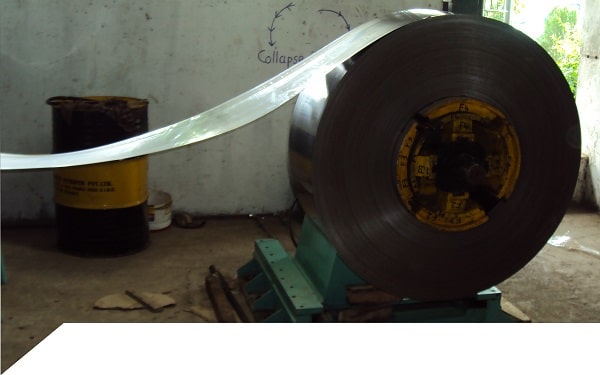
A slitting line or cut-to-length line works by applying controlled force to the strip: bending it through a leveller, shearing it between knives, gripping it in pinch rolls and pulling it under tension. How the material responds to that force depends on properties such as:
- Yield and tensile strength: How much force is needed to deform or cut it
- Work hardening: Whether it becomes harder as it is deformed
- Stiffness (elastic modulus): How much it springs back after bending
- Surface sensitivity: How easily its finish is marked or scratched
- Coating: Whether there is zinc, paint or film on the surface that must be protected
These properties affect cutting force, tooling choice, edge quality, flatness, surface protection and winding behaviour. A line configured for one material may need different tooling, roll surfaces or handling features to process another well.
Carbon Steel
Carbon steel, in hot-rolled, pickled, cold-rolled and coated forms, makes up most of the tonnage processed in typical service centres. It is the reference point against which most slitting and cut-to-length lines are designed.
Main considerations
- Thickness and strength range: Carbon steel covers a wide band, from thin cold-rolled sheet to thick hot-rolled plate and high-strength grades. The upper end of the thickness and strength range sets the required cutting force, motor power and machine rigidity.
- Hot-rolled surface: Hot-rolled coils may carry mill scale, which is abrasive and affects tooling and roll wear. Pickled and oiled material is cleaner but still needs handling care.
- Coated steel: Galvanised and pre-painted steel need their coatings protected through the line. Our article on GI coil slitting for solar mounting structures discusses this in an application context.
- Shape: Heavier carbon steel often arrives with significant coil set and shape defects, which makes levelling capability important in cut-to-length work.
Stainless Steel
Stainless steel is chosen for its corrosion resistance and appearance, and both of those qualities set processing priorities.
Main considerations
- Work hardening: Austenitic grades such as 304 and 316 harden noticeably as they are deformed. That raises the force needed to cut them and makes edge quality more sensitive to knife sharpness and clearance. Clearance that works for mild steel of the same thickness is usually not correct for stainless.
- Higher cutting force: For a given thickness, stainless steel generally requires more force to slit or shear than mild steel. Machine capacity should be checked against the hardest stainless grade and thickest gauge planned, not just against carbon steel.
- Surface finish: Many stainless products are sold on their finish, from 2B to bright annealed and polished. Rolls, guides and contact surfaces need to avoid marking, and protective film or interleaving may be needed.
- Contamination: Plants that process both carbon steel and stainless often take care to avoid transferring iron particles onto stainless surfaces, which can later cause staining. This affects cleaning practice and sometimes tooling allocation.
The Nickel Institute publishes practical guidelines for the fabrication of austenitic stainless steels, including guidance on cutting and finishing, which is a useful background reference for teams new to the material.
Aluminium
Aluminium is light, soft in many tempers and easily marked, which brings a different set of priorities.
Main considerations
- Surface sensitivity: Aluminium scratches and dents easily. Roll surfaces, handling equipment and packing all need attention to protect the finish.
- Material pick-up: Softer aluminium alloys can build up on tooling, which affects edge quality and may require cleaning or lubrication.
- Lower stiffness: Aluminium’s elastic modulus is roughly a third of steel’s, so it responds differently to bending and tension. Tension and levelling settings that suit steel can distort aluminium.
- Thin gauges: Aluminium is often processed in thin gauges, where tension control and strip guidance become critical.
We looked at these issues in more depth in Aluminium Coil Slitting: Challenges and Machine Requirements.
Other Materials Processors Handle
Coil processors also work with electrical steels, tinplate, copper and brass. Each brings its own requirements. Electrical steel, for example, is sensitive to burr and mechanical stress because of its magnetic function, which we covered in Electrical Steel (CRNO) Slitting.
Running Several Materials on One Line
A single line can often process several materials, provided it was designed for them. In practice that usually means:
- Sizing the machine for the most demanding combination of strength and thickness
- Specifying roll surfaces and contact materials that protect the most sensitive finish
- Providing a tension and speed range that covers both stiff and soft materials
- Planning separate tooling sets or tooling allocation by material where needed
- Adding options such as interleaving, protective film or lubrication where the product range requires them
- Setting up cleaning and changeover procedures between materials
What should be avoided is assuming that one setting, or one tooling set, will work across every grade and thickness. Each material and thickness combination needs its own proven setup.
What to Include in Your Enquiry
When requesting a quotation for a Metal Slitting Line or Cut to Length Line that will process more than one material, give the manufacturer:
- Every material and grade to be processed, with typical and maximum tensile or yield strength
- Thickness and width range for each material
- Surface finish and coating requirements, including any protective film
- Edge quality, burr, flatness and tolerance requirements for each product
- The expected share of each material in your production
- Coil weights and dimensions for each material
Valgo’s published slitting line range lists materials including carbon steel, galvanised steel, silicon steel, tinplate, stainless steel, pre-painted steel and aluminium. Confirming exactly which combinations a specific line configuration will handle is part of the specification review for each project.
Conclusion
Stainless steel, aluminium and carbon steel each ask different things of a coil processing line: more cutting force, more surface protection, or more careful tension control. A line can handle several of them well when its design and setup account for every material from the start. When it does not, edge quality, surface finish and productivity suffer.
Share your material grades, dimensions and output specifications with Valgo, and our team can review the configuration your product mix requires. Contact Valgo Group to start the discussion.
