

A slit coil can look perfect on the recoiler and still cause trouble a week later in a customer’s plant. A strip that runs a fraction of a millimetre wider than specified may jam in a roll-forming entry guide. One that runs narrow can leave a tube mill short of material at the weld seam, or force a press shop to widen its scrap allowance. In most cases, the problem traces back to one number on the order: the slit width, and how consistently the slitting line held it.
This article looks at strip width accuracy from the downstream user’s point of view. It covers what width tolerance actually means, why it matters in forming and feeding operations, which factors on a slitting line influence it, and what buyers and processors should specify and check.
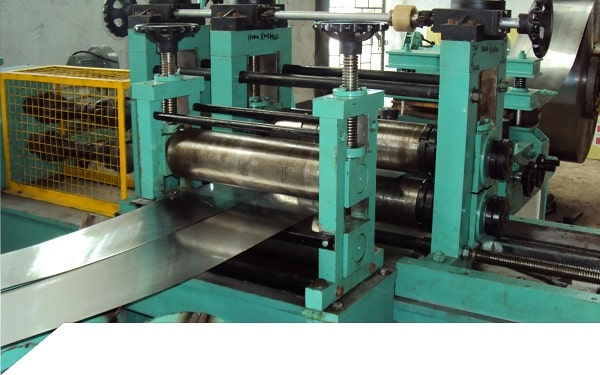
Nominal Width, Tolerance and Why Both Need to Be Written Down
Every slit strip has a nominal width, the target dimension on the order, and a width tolerance, the permitted deviation from that target. A strip ordered at 125 mm with a tolerance of +0.2/−0 mm, for example, is acceptable anywhere between 125.0 and 125.2 mm. The same strip ordered at ±0.1 mm has a narrower window that sits on both sides of nominal.
The way the tolerance is written matters as much as its size. Some downstream processes can accept a slightly wide strip but not a narrow one, so a one-sided (plus-only) tolerance suits them. Others need the strip centred on nominal. If the order simply says “125 mm” with no tolerance, the processor and the customer are relying on different assumptions, and disputes follow.
Published standards give a common reference point. For example, EN 10140, the European standard for cold rolled narrow steel strip, sets tolerances on thickness, width, edge camber and flatness for strip under 600 mm wide. In India, BIS documentation for IS 513 (Part 1) cold reduced carbon steel sheet and strip refers to a dedicated dimensions and tolerances clause. Many slit-coil customers, especially in automotive, electrical and precision tube work, set tighter in-house limits than these general standards. Whichever reference applies, it should be named on the purchase order.
Where Width Errors Show Up Downstream
Width accuracy is rarely a concern in isolation. It matters because of what happens to the strip next.
Roll forming
Roll-formed sections are designed around a specific strip width. Extra width has to go somewhere, usually into flange length or an uneven lip. Too little width shortens a flange or prevents the profile from closing correctly. Width variation along the coil length means the operator may have to keep adjusting the mill instead of running steadily.
Tube and pipe mills
In welded tube production, strip width sets the circumference of the formed tube before welding. Width variation affects the edge presentation at the weld point and can lead to inconsistent weld quality or outside-diameter variation that has to be corrected later.
Press feeding and progressive dies
Feeders and stock guides are set to a strip width. A strip that wanders in width can bind in the guides or, if the guides are opened up to accommodate it, lose the lateral location that the die depends on.
Material planning and yield
Width tolerance also affects how a processor plans a master coil. If a line can hold width consistently, the slitting plan can be set closer to the customer’s lower limit with less edge trim allowance. If it cannot, planners build in extra width as insurance, and that extra material is paid for on every coil. Our earlier article on reducing material waste in coil slitting discusses how setup practice and planning interact.
What Influences Width Accuracy on a Slitting Line
Width accuracy is a result of the whole system, not a single setting. The main contributors are below.
Tooling precision and stack-up
On a rotary slitter, strip width is set by the positions of the knives on the arbors, which are in turn set by spacers. Every knife and spacer carries its own manufacturing tolerance, and those small errors add up across the tooling set. A technical article in The Fabricator on avoiding coil slitting problems notes that tooling not made to the correct tolerances for the application behaves like damaged tooling, and that nicked or dented spacers will not seat properly. Clean, undamaged, precisely ground tooling is the foundation of width control.
Knife clearance and overlap
Horizontal clearance between upper and lower knives and vertical overlap both affect how the material separates. The same Fabricator article states plainly that if horizontal clearance is not right, the width will change. Clearance also needs to suit the material grade and thickness, and there is no universal formula that replaces trial and inspection. Clearance and overlap also drive burr and camber, which we covered in detail in Camber and Burr Defects in Slit Coils.
Arbor rigidity and machine condition
Arbor and knife deflection under cutting load, along with worn bearings, let the tooling move during cutting. Heavier gauges and harder materials generate higher cutting forces, which is one reason width variation tends to be more pronounced on thick material. Machine rigidity and maintenance therefore show up directly in width results.
Strip guidance and tension
If the strip enters the slitter head at an angle or wanders laterally, the cut moves relative to the strip. Entry guides, a properly set loop, and consistent back tension help keep the strip tracking straight through the knives.
Incoming material
Master coils vary in thickness profile, edge condition, hardness and shape. A coil with significant crown or camber is harder to slit to a tight width than a well-shaped coil. Incoming inspection gives the operator a chance to adjust before the problem reaches the customer.
Measuring and Sampling Width
A tolerance is only meaningful if it is measured in a consistent way. A few practical points:
- Measure at defined points. Agree where samples are taken, typically at the head and tail of each slit coil and at intervals for long runs.
- Use appropriate instruments. Calibrated vernier or digital calipers are common for routine checks. Tighter tolerances may call for micrometers, width gauges or in-line measurement.
- Measure every strip position. Outer strips and inner strips can behave differently, so check each cut position, not just one strip per set-up.
- Record the results. A simple width log per coil helps identify drift caused by tooling wear and gives the customer traceable evidence.
- Allow for temperature. For very tight tolerances, measuring warm strip immediately after a long run and cool strip later can give slightly different readings. Agree on measurement conditions with the customer where this matters.
What to Specify When Ordering or Buying Equipment
Whether you are placing a slit-coil order or specifying a new Metal Slitting Line, the same information drives the result:
- Material grade, thickness range and coating, if any
- Nominal slit widths, including the narrowest strip you expect to produce
- Required width tolerance for each product, and whether it is one-sided or symmetrical
- Other edge and shape requirements, such as burr height and camber limits
- Applicable standard or customer specification
- Measurement method and sampling frequency for acceptance
Equipment manufacturers publish the accuracy their lines are designed for. Valgo’s heavy gauge slitting line models, for instance, list a slitting accuracy of ±0.1 mm. Accuracy achieved in production also depends on tooling, setup, material and maintenance. When a project has demanding width requirements, it is worth discussing them in detail at the enquiry stage and confirming them during trials with your own material.
A Short Checklist for Production Teams
- Is the width tolerance written on every order, including its direction?
- Are knives and spacers inspected, cleaned and stored to protect their faces?
- Are knife clearance and overlap set for the specific grade and thickness?
- Is the strip tracking straight into the slitter head?
- Are width checks taken at every strip position, at agreed points, and logged?
- Is width drift over a run reviewed as a sign of tooling wear?
Conclusion
Strip width accuracy is a downstream promise. When it is specified clearly, measured consistently and supported by well-maintained tooling and machinery, it lets customers run their forming, welding and pressing operations without constant adjustment. When it is left vague, the cost appears later as scrap, downtime and complaints.
If you are planning a new line or reviewing the width capability of an existing one, Contact Valgo Group with your target widths, material and inspection requirements, and our team can discuss a suitable configuration.
